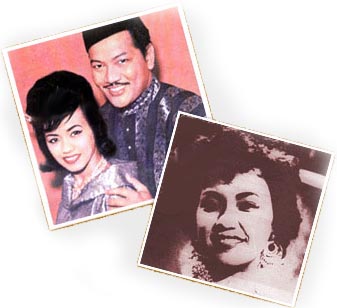
Titiek Sandhora’s enduring singing career and fame is remarkable. Her first recorded song Si Boncel stormed the airway in Indonesia in the late 60’s. Muchsin Alatas had his own hits like Merana and Gadis Lesung Pipit. REMACO then decided that the two of them should sing a few duets. It was the beginning of a very successful partnership. Their many beautiful love songs soon also found a loyal fan base in the neighboring Malaysia and region in the post Indonesia-Malaysia Confrontation (1962-1966). The fairytale couple finally married in 1972.
(DUNIA BELUM KIAMAT)
Pikir-pikir sampai tua
Dari miskin siapa
Yang mau
Sabarlah sabar
Tunggu dulu
Belum tentu orang
Tak mau
Sudah kupikir sama saja
Jauh tinggi bulan
Dan bintang
Sampai kemana abang
Mimpi
Banyak pikir-pikir
Merusak hati
Kembang tidak setangkai
Dunia belum kiamat
Panjang umur dan ada jodoh
Banyak gadis pilihan
Banyak janda uwik uwik
Dunia belum kiamat
Kalau begini apalagi
Tentu adik suka padaku
Pikir sendiri tebak saja
Tentu tahu isi hatiku…
Kandiah Kamalesvaran (Tamil: கந்தையா கமலேஸ்வரன்) or Kamahl was from the graduating class of 1952 at “V.I.” (Victoria Institution) in Kuala Lumpur. He did his matriculation in Australia and stayed. He recorded with Philips and “Dreams of love” became a gold hit in 1969. In 1974, he joined the New Zealand Studio One television competition and won with “End of a rainbow” (by Earl Grant). A big break came the following year when Frank Sinatra turned down World Wildlife Fund (WWF) and Kamahl was invited to sing “The Elephant Song” for the musical finale of a TV Special. The song introduced Kamahl to Europe where it topped the charts in several countries and was number 1 in Holland. His sensational international recording and concert career spanned over four decades including performances for Queen Elizabeth II at the Royal Command Performance (1982), the London Palladium, Carnegie Hall and Talk of the Town. In 1994, he was bestowed the title AM, a Member of the Order of Australia.
New Zealand Studio One TV, 1974
Australian releases in Singapore-Malaysia (1970 – 1978): Kamahl
Kamahl in Holland
Friends
I think of you
Kamahl at the Opera House
Let it be me
If I give my heart to you
Love is a beautiful song
Portrait of my love
This love we share (Australian release 1984) Christmas with Kamahl (Australian release 1984)
(END OF A RAINBOW)
At the end of a rainbow, you’ll find a pot of gold
At the end of a story, you’ll find it’s all been told
But our love has a treasure our hearts can always spend
And it has a story without any end
At the end of a river, the water stops its flow
At the end of a highway, there’s no place you can go
But just tell me that you love me and you are only mine
And our love will go on ’til the end of time
At the end of a river, the water stops its flow
At the end of a highway, there’s no place you can go
But just tell me that you love me and you are only mine
And our love will go on ’til the end of time
So darling tell me that you love me and you are only mine
And our love will go on ’til the end of time
Comments Off on Kamahl | Kamahl | Permalink Posted by franas
Lata Mangeshkar (Hindi: लता मंगेशकर,) was India’s most recorded singer, supreme voice of Hindi popular and light classical music, pop, and musical forms of ghazal and bhajan. The Indian subcontinent is geographically in South Asia but has always “look East” with fairly large settlements and communities in Myanmar (Burma), Malaysia, and Singapore. The culture, influence and presence of Indian music and Bollywood in East Asia is prominent.
* Lata Mangeshkar has charmed her fans with over 50,000 songs she has sung as a playback singer in films. Until the 1991 edition, when her entry disappeared, the Guinness Book of Records listed her as the most recorded artist in the world with not less than 30,000 solo, duet and chorus-backed songs recorded in 20 Indian languages between 1948 and 1987.
[Recently at Hotel Jaypee Palace in Agra, I met musician Arun Saxena who was very kind to give me a CD selection of Hindi songs. His excellent instrumental rendition of the popular hit of Bachpan ki muhabbat by Lata Mangeshkar (from the movie Barju Baura , 1953) is presented here. *The song was sang in Chinese (心里的火花) in the 60’s by Pan Xiu Qiong 潘秀琼]
(BACHPAN KI MUHABBAT)
*Bachapan kee mohabbat ko, dil se naa judaa karanaa
Jab yaad meree aaye, milane kee doowaan karanaa
Ghar meree ummeedon kaa sunaa kiye jaate ho
Duniyaa hee mohabbat kee loote liye jaate ho
Jo gam diye jaate ho, us gam kee dawaa karanaa
Saawan mein papee ke saath sangeet churaoongee
Farayaad tumhe apanee gaa gaa ke sunaaoongee
Aawaaj meree sun ke, dil thaam liyaa karanaa
(English translation)
Do not remove love of my youth from your heart
Pray for a meeting if you remember me
You are emptying my abode of hope
You are looting my world of love
You have to give medicine for unhappiness given by you
i will steal music of PAPIHA bird in rainy season and will plead before you with a song
You clutch your heart whenever you hear me singing
Do not forget the love of my youth my love
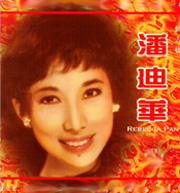
Rebecca Pan 潘迪華 was another singer to rise to prominence during the burgeoning early 1960s cabaret scene in Hong Kong. A mixed of Mandarin and English repertoires were the rave. Rebecca’s bilingual interpretation of Rose, Rose, I love you in 1961 was classic. She followed up in 1965 with another Chinese song that had successfully translated into the West earlier: Second Spring (第二春), composed by Yao Min 姚敏 and sang by Dong Bei Bei 董佩佩 in Shanghai, and also was recorded by Tsai Chin (also known as Irene Chow, 姚莉) as Ding Dong Song in 1959 after it featured in the London stage musical The World of Suzie Wong. The English lyrics were composed by Lionel Bart.
Rebecca Pan has enjoyed a very successful career which now spans five decades. Her Live In The Eagle’s Nest was Hong Kong’s first live album and Pai Niang Niang – The Legend of the White Snake 白孃孃 was also the first original Mandarin musical on the island.
Rebecca Pan’s acclaimed bilingual version of Ding Dong Song and The isle of Pulau Bali are featured here, followed by the original Mandarin version of Second Spring by Dong Bei Bei.
Dong Bei Bei 董佩佩
(Original Chinese lyrics of Second Spring by Dong Bei Bei)
明明是冷冷清清的長夜
為甚麼還有叮叮噹噹的聲音
聽不出是遠還是近
分不出是夢還是真
好像是一串鈴
打亂了我的心
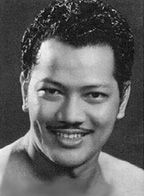
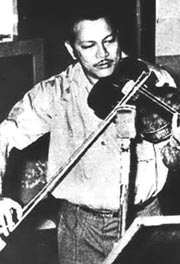
P. Ramlee, actor, movie director, singer and songwriter. He was an icon of Malay entertainment and the “golden son” of Malaysia. Born and grew up in Penang, he sang and played several instruments in various bands. In 1948, he was spotted by Shaw Brothers/Malay Film Productions (popularly known as Ampas Road Studio) while he was singing his own composition Azizah (about a mysterious childhood sweetheart) at Bukit Mertajam. He was invited to join the outfit in Singapore as a playback singer for movies. Shortly, he was able to get his screen break in Chinta. Many other movies followed but it was in Bakti where Ramlee became the first actor to sing his own songs. He became a full-fledged director in Penrarik Beca which contained the song which started it all, Azizah.
P. Ramlee (together with his third wife, the beloved Saloma) revolutionized Malay popular music by drawing on a rich traditional (asli, inang, joget, masri, zapin and keroncong) repertory while incorporating many western musical elements and instruments with a dance hall orchestra. He was posthumously awarded with the Malaysian honorific title Tan Sri .
During his career, he directed and acted in sixty-six films, and had more than 360 songs to his credit. Among his films that received awards are:
1) Best Musical Score for Hang Tuah (3rd Asian Film Festival, Hong Kong (1956)
2) Best Male Actor for Anak-ku Sazali (4th Asian Film Festival, Tokyo (1957)
3) Best Comedy Film for Nujum Pak Belalang (7th Asian Film Festival, Tokyo (1960)
4) Most Versatile Talent for Ibu Mertua Ku (10th Asian Film Festival, Tokyo (1963)
5) Best Comedy Film for Madu Tiga (11th Asian Film Festival, Taipei (1964)
Saloma, the legendary actress/singer, was born in Singapore. She was singing and performing at a young age. When she was of age, she started singing in nightclubs. Soon, her acclaimed pure and melodious voice captivated an audience. She was offered movie contracts where she played lead roles featuring her prominent singing ability. P. Ramlee and Saloma married in 1961. They were adored by their fans. They quickly became the country’s very own “screen couple”!
* National Awards:
1975, Awarded the Ahli Mangku Negara (AMN)
1979, Biduanita Negara (National Celebrity Award)
(BUNYI GITAR)
Oh bunyi gitar
Irama twist
Tidak sabar
Si gadis manis
Dengar lagu rancak gembira
Hatinya rindu tergoda
Ingin dapat teman
Menari suka ria
Sungguh merdu
Lagu ini
Siapa mahu
Boleh menari
Pilih satu teman sendiri
Ataukah si hitam manis
Kalau sudi mari, kita menari twist
Oh gitar berbunyi
Menawan hati sedang berahi
Oh rancaknya irama
Dapat mikat sukma
Gadis dan teruna
Mari cari teman gembira
Gitar solo
Dan melodi
Ikut tempo
Kalau menari
Sila adik, sila cik abang
Marilah kita berdendang
Irama gembira
Hati jadi riang
Pan XiuQiong 潘秀瓊 is known as the “Queen of Alto”, alongside the great Mandarin singers from the era. She is the pride and shining star originally from Ipoh, Malaysia. She sang the unforgettable “Lover’s tears” 情人的眼淚 in the movie The Lark (Shaw Brothers, 1965). Another classic is the stirring Book of Life 家家有本难念的经 which is a simple yet direct philosophical statement about (family) life. She popularized many songs which originated from the region like 峇厘島 (Bali) and 梭羅河之戀 (Bengawan Solo, also called 梭羅河畔 when Koo Mei 顧媚 recorded it later).
* Zhou Xuan 周璇 (Golden Voice of Old Shanghai), Yao Lee 姚莉 (Singer of the Era), Li Xiang Lan 李香兰 (Queen of Soprano), Wu Ying Yin 吳鶯音 (Queen of Nasal Singing).
為 什 麼 要 對 你 掉 眼 淚
Why am I shedding tears for you
你 難 道 不 明 白 為 了 愛
How can you not know it is for love
只 有 那 有 情 人 眼 淚 最 珍 貴
Only for one with feelings are tears so precious
一 顆 顆 眼 淚 都 是 愛 都 是 愛
Each teardrop is for love, all are for love
為 什 麼 要 對 你 掉 眼 淚
Why am I shedding tears for you
你 難 道 不 明 白 為 了 愛
How can you not know it is for l
要 不 是 有 情 郎 跟 我 要 分 開
If my lover were not leaving me
我 眼 淚 不 會 掉 下 來 掉 下 來
My tears would not be falling, not be falling
好 春 纔 來 春 花 正 開
Spring has returned, spring flowers bloom
你 怎 捨 得 說 再 會
How can you say farewell
我 在 深 閨 望 穿 秋 水
I stay at home, impatiently waiting
你 不 要 忘 了 我 情 深 深 如 海
Do not forget my love, deep as the ocean
為 什 麼 要 對 你 掉 眼 淚
Why am I shedding tears for you
你 難 道 不 明 白 為 了 愛
How can you not know it is for love
要 不 是 有 情 郎 跟 我 要 分 開
If my lover were not leaving me
我 眼 淚 不 會 掉 下 來 掉 下 來
My tears would not be falling, not be falling
Jose Mari Chan, composer, singer and businessman. He wrote and recorded Afterglow in 1967 which became a big hit, a significant achievement at a time when foreign music dominated the industry in the Philippines. Dyna took notice and asked JM to do an album with original songs. From it, Deep in my heart became a national hit. Even as music was relegated to the sideline (“You can’t raise a family on that. Music is not a stable livelihood”) while he helped to run the thriving family sugar business, JM still managed to earn a string of nominations from FAMAS for his original themes and scores for about 26 movies between 1970 to 1974. For about 10 years after that, with Marcus nationalizing the sugar industry, JM lived in the US and traveled widely in Central and South America with a trader’s visa. Never too far away from music, JM continued to write songs. When the EDSA Revolt succeeded, JM was soon back in the Philippines. In 1989, the album “Constant Change” was released and reached diamond record in sales. The hit single Beautiful girl became a timeless song in all of SE-Asia and beyond.
JM Chan’s illustrious musical career spans four fruitful decades. In 2005, he composed We’re all just one, the theme song of the 2006 Southeast Asian Games. He is first in many categories: First Filipino and the only recording artist who achieved a Double Diamond Record Award, for the biggest selling Christmas album, “Christmas in our hearts”, and; First Filipino and the only singer/composer/producer that has been bestowed lifetime achievement awards by The Philippine Association of the Record Industry’s Awit Awards, the composer’s group Katha Awards and Aliw Award.
(BEAUTIFUL GIRL)
Beautiful girl, wherever you are
I knew when I saw you, you had opened the door
I knew that I’d love again after a long, long while
I’d love again
You said “hello” and I turned to go
But something in your eyes left my heart beating so
I just knew that I’d love again after a long, long while
I’d love again
*It was destiny’s game
For when love finally came on
I rushed in line only to find
That you were gone
Whenever you are, I fear that I might
Have lost you forever like a song in the night
Now that I’ve loved again after a long, long while
I’ve loved again
*It was destiny’s game
For when love finally came on
I rushed in line only to find
That you were gone
Beautiful girl, I’ll search on for you
‘Til all of your loveliness in my arms come true
You’ve made me love again after a long, long while
In love again
And I’m glad that it’s you
Hmm, beautiful girl
Yao Lee’s (姚莉) singing career spanned from the 1930’s thru 1970’s. Her most famous song, Rose, Rose, I love you (玫瑰玫瑰我愛你), became the only song written by a Chinese which was to become a major English-language international hit. She recorded the song in Shanghai in 1940. The song is representative of a very unique period in Chinese popular music, the shidaiqu (時代曲 – music of the time or popular music), which is considered to be the early model of the modern Mandopop 流行音.
Frankie Laine recorded the song in English in 1951. It reached #3 on the Billboard music chart. In the English version of Rose, the lyrics were changed and Rose became the mysterious “Flower of Malaya”. She was later identified as Rose Chan, an iconic striptease dancer who was very familiar to the American and British nationals stationed in Malaya and Singapore during the post-war era. Rose, Rose, I love you continues to be very popular, and has been recorded by Petula Clark and countless singers over the decades. Yao Lee’s original version also appeared in the soundtrack of The Pillow Book (Peter Greenaway, 1996).
The original Chinese lyrics of Rose, Rose, I love you were composed by Wu Cun (吳村) and the music was credited to Lin Mei (林枚), a pen name for popular song composer Chen Gexin (陳歌辛). Yao Lee recorded it in 1940 as an interlude for the movie Singing Girl (天涯歌女). The song proved to be so popular that it was released as a single on Pathé Records (EMI). The English language lyrics were written by a British correspondent, Wynford Vaughan Thomas. Frankie Laine recorded it with the Norman Luboff Choir and Paul Weston and his orchestra in 1951 on Columbia Records.
* 1930s – 1940s: The Seven Great Singing Stars (Republic of China):
Bai Guang (白光, White Light)
Bai Hong (白虹, White Rainbow)
Gong Qiuxia (龔秋霞)
Li Xianglan (李香蘭, Yoshiko Otaka 大鷹淑子)
Wu Yingyin (吳鶯音)
Yao Lee (姚莉, Silver Voice)
Zhou Xuan (周璇, Golden Voice)
(English translation of the original song)
Rose, Rose, so stunning!
Rose, Rose, so ravishing!
You open in late summer on tip of a branch,
Rose, Rose, I love you!
Rose, Rose, you touch me deeply,
Rose, Rose, my love is true.
You open in late summer beside the thorns,
Rose, Rose, I love you!
I pledge my heart, my tender love,
Your pure brilliance radiates the whole world.
I pledge my heart, my tender love,
Your pure radiance illuminates the world.
Rose, Rose, so stunning!
Rose, Rose, so ravishing!
Opens in late summer on tip of a branch,
Rose, Rose, I love you!
Rose, Rose, your limbs so slender,
Rose, Rose, your thorns so sharp.
Today stormy rains may ravage you,
Bruising your limbs and graceful body.
Rose, Rose, your heart is hard.
Rose, Rose, your thorns are sharp.
In future stormy rains may ravage you,
May crush your mellow fruit.
Yūzō Kayama (加山雄三,Kayama Yūzō?) was one of Japan’s biggest male stars in the 60’s. He was a popular TV personality and movie actor as well as a gifted musician. A big star of Eleki (the instrumental electric guitar boom) and inspired by The Ventures’ tour in 1965, Yuzo Kayama formed The Launchers and began to play full-on surf music. They were so successful that The Ventures even recorded two of their songs, Black Sand Beach and Yozora No Hoshi. The Launchers were signed to Toshiba Records with a caveat in the contract that Yuzo Kayama would sing to widen the band’s appeal. Yuzo Kayama did sing, and his songs such as Boomerang Baby and Mafuya No Kaerimichi were huge hits. WhenKimi To Itsumademo (君といつまでも,Forever With You?) was released in 1965, it sold an estimate 3 million copies.
Note: Yuzo Kayma was also credited with coining the term Group Sounds (GS) on his own live TV chat show in 1964.
The Launchers: Yuzo Kayama (guitar), Osamu Kitajima (guitar), Yuzo Watanabe (bass), Ei Kitajima (drums).
Yuzo Kayama with The Ventures
(君といつまでも KIMI TO ITSUMADEMO)
二人を夕闇が 包むこの窓辺に
Futari no yuuyami ga Tsutsumu kono madobe ni
fF明日も素晴らしい 幸せが来るだろう
Ashita mo subarashii Shiawase ga kuru darou
君の瞳は星と輝き
Kimi wo hanasanaizo
恋するこの胸は 炎と燃えている
Koisuru kono mune wa Honoo to moete iru
大空染めて行く 夕陽色あせても
Oozora somete yuku Yuuhi iro asetemo
二人の心は 変わらないいつまでも
Futari no kokoro wa Kawaranai itsumademo
幸せだな
Shiawase da na
僕は君といると時が
Boku wa kimi to iru toki ga
一番幸せなんだ
Boku wa shinu made ichiban shiawase nanda
僕は死ぬまで Boku wa shinu made
君を離さないぞ Kimi wo hanasanaizo
いいだろう?」 II darou?”
君はそよ風に 髪をとかせて
Kimi wa soyokaze ni Kami to tokasete
優しくこの僕の しとのにおくれ
Yasashiku kono boku no Shitono ni okure
今宵も日が暮れて 時は去りゆくとも
Koyoi mo hi ga kurete Toki wa sariyuku to mo
二人の思いは 変わらないいつまでも
Futari no omoi wa Lawaranai itsumademo
In the wake of the Beatles’ visit to Tokyo, Japanese bands began to imitate the group vocal routine; hence, the term Group Sounds (GS) was coined by the Japanese Press. Emy Jackson, born in Japan but raised in England, released the very successful SP 涙の太陽 Crying in a storm in 1966. The backing was done by The Smashmen playing a surf-styled guitar and heavy drumming which clearly showed the influence of The Ventures in J-pop.
(Note: Rita Chao & The Quests also covered Crying in a storm and Say yes, my boy 夢見るマイ・ボーイ)
CBS (Japan) 1994: The Emy Jackson Album Crying in a storm, Pretend, I gave all my love to you, Crying in the chapel, Little white clouds that cried, Don’t break my heart, Say yes, my boy, If I give my heart to you, Tears A-go go, I went to your wedding, Frankie, Suddenly I’m alone
(CRYING IN A STORM)
Take me, take me, take my heart and all, I was born to be yours
Love me, love me, get me, hold me tight, now I’m crying in a storm
I know that you take them in your crazy sport car, Kitty, Chris, Ronnie, Julie, Nancy and Patsy
Why, why not me
Take me, take me, take my heart and all, I was born to be yours
This blog is intended for showcasing the best of the local singers and bands in the Far East in the 60's. To display Asian characters properly, you may need to update your browser for additional language support. Since the music files are constantly being updated, you also need to refresh and clear the cache in your browser to hear the changes. I encourage listeners to actively support the local artists and recording companies. You can do this by purchasing commercial re-release of the songs if you have enjoyed them here.
Contributing articles and info are welcome and will be properly credited.
1) The Quests, Part 1
2) The Quests, Part 2
3) The Quests in Malay (with Malay artists)
4) The Surfers
5) The Thunderbirds
6) Susan Lim & The Crescendos
7) Naomi Suriya & The Boys
8) Heather & The Diamond Four, The Thunderbirds
9) Shirley Nair & The Silver Strings
10) Rose Iwanaga & The Avengers
11) Suyin (舒雲) & The Quests
12) The Fabulous Echoes
13) Off-beat Cha Cha with Kong Ling ( 江玲) & The Fabulous Echoes
14) The Early Years: Wong Ching Yian (黄清元) & The Melodians. The Stylers
15) Radio show – Retrospective Part 1 (The Decade)
16) Radio show – Retrospective Part 2 (Instrumentally Yours)
17) Radio show – Retrospective Part 3 (A Spiritual Sojourn)
18) Sakura Teng & The Quests.
19) Rita Chao & The Quests, The Surfers
20) Hot August Nights: Rockin’ with “RJ” in Manila
21) QBS Christmas Party (Keep Christ in CHRISTmas!)
22) Gong Xi Fa Cai! (Chinese Year 4714)
23) Happy Valentine’s Day
24) Happy Mother’s Day
25) Reg Guitar 乐雅吉打乐队 (Part 1)
26) Reg Guitar 乐雅吉打乐队 (Part 2)
27) Remembering Jap Chong (of The Quests)
28) The Inimitable Teresa Teng (鄧麗君)
29) The Tielman Brothers (Andy Tielman)
30) Remembering Reggie Verghese (of The Quests)
 <a
<a


 Posted by franas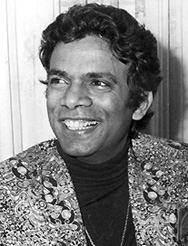








 QUESTING bandstand
You must be logged in to post a comment.